
Curl grubs or armyworm: what's killing your lawn
Brown, dying patches of lawn get blamed on all sorts of things, but two of the most common causes in Australian lawns are curl grubs and armyworm. They look similar from a distance, both show up as patches that seem to appear out of nowhere, but they damage the lawn in different places and need different responses. Getting the wrong one means treating the wrong problem.
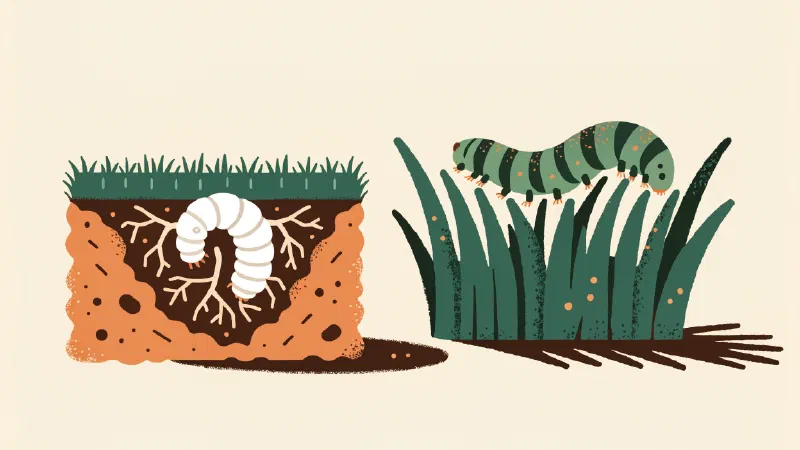
Curl grubs attack from underneath
Curl grubs are the larvae of scarab beetles, including species such as the African black beetle and the Argentinian scarab, according to Yates Australia. They live in the soil and feed on grass roots from below, which means the damage starts underground and only shows up on the surface once enough root has been eaten away.
The tell is in how the lawn feels underfoot. Affected areas go spongy, and because the roots are gone, the grass can be pulled away from the soil almost like a loose carpet, revealing chewed-off roots underneath. Increased bird activity, particularly birds digging at the lawn early in the morning, is another sign, since they’re after the grubs themselves.
Armyworm attacks from above
Armyworm caterpillars work the opposite way. They feed on the leaf blade above ground, stripping grass back to bare stems in patches that spread in an advancing line, sometimes overnight once numbers build up. Because the roots and crown of the plant are usually untouched, an armyworm damaged lawn stays firmly rooted in the ground, even though the leaf itself looks stripped bare.
The tug test tells you which one you’ve got
This is the simplest way to separate the two without any special testing. Grab a handful of the damaged grass and pull gently.
- If it lifts away easily with little resistance, and the roots underneath look chewed or missing, that’s consistent with curl grub damage.
- If it stays firmly rooted and only the leaf is gone, that points to armyworm.
For a second opinion, both pests can be confirmed with a bucket of soapy water poured over the patch: curl grubs are less reliably drawn up this way than armyworm, since they sit deeper in the soil, but the soapy water test remains the standard first check Jimboomba Turf Group recommends specifically for armyworm, since the caterpillars will wriggle to the surface within about ten minutes if present.
Bird activity is a clue either way
Increased bird activity on the lawn, particularly early morning digging in a specific patch, is worth paying attention to regardless of which pest turns out to be responsible. Birds are usually after the curl grubs themselves rather than armyworm caterpillars, so a patch of lawn that’s suddenly attracting a lot more bird interest than the rest of the yard is often the same patch worth running the tug test and the soapy water test over first.
Why the distinction matters for how you fix it
Curl grub damage needs the soil-dwelling larvae treated and, once the roots are gone, usually needs the affected turf replaced rather than left to recover, since there’s nothing left underground to regrow from. Armyworm damage, by contrast, often bounces back on its own once the caterpillars are dealt with, because the roots and crown are still intact underneath.
If you’ve caught it early and you’re trying to work out which pest you’re dealing with before it spreads further, lawn armyworm in South East Queensland: spotting it early covers the seasonal pattern and the early warning signs specifically for armyworm.
Stump Boss does stump grinding and lawn aeration from North Brisbane to the Sunshine Coast. If you would like the lawn cored or a stump ground out, send a few photos and get a quote.
Stump Boss does stump grinding and lawn aeration from North Brisbane to the Sunshine Coast.