
Do Tree Stumps Attract Termites in South East Queensland
A stump sitting in the yard doesn’t look like much of a problem once the tree itself is gone. To a termite colony, though, it can be exactly what they’re after.
Why stumps are attractive to termites
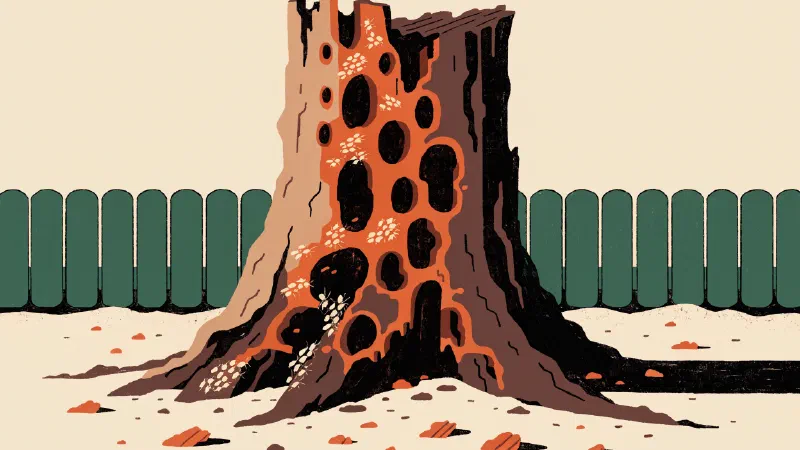
A tree stump gives termites three things they need in one place: a food source in the timber itself, a water source because stumps hold moisture, and shelter in the dark, damp crevices as the wood starts to break down. As the timber ages and softens, it becomes progressively easier for a colony to work through, which is why an older stump is generally more attractive than a freshly cut one.
Eucalypts, which make up a huge share of the trees across South East Queensland’s older suburbs and acreage blocks, are exactly the kind of timber termites are known to favour. That’s not a reason to panic about every gum tree stump in the yard, but it is a reason not to leave one sitting indefinitely if you can help it.
The risk isn’t just to the stump
Once a colony establishes in a stump, it isn’t necessarily staying there. Subterranean termite species build tunnels to move between a food source and other structures nearby, and those tunnels can stretch further than people expect, potentially linking a stump to garden beds, a shed, a fence line, or the timber in a house. A stump close to the house is a genuinely different risk profile to one out the back of an acreage block.
Signs a stump already has activity
Mud tunnels running up the outside of the stump, or across nearby brickwork or fencing, are one of the more obvious signs of subterranean termite activity. Wood that sounds hollow when tapped, or that crumbles more easily than you’d expect for its age, is another. None of these signs are a certain diagnosis on their own, which is exactly why a licensed inspection is worth getting rather than guessing from the outside.
What to do if a stump already has termite activity
If a stump already has live termites or an active nest in it, the usual professional approach is to treat the colony first with a non repellent termiticide before disturbing the stump, so the treatment has a chance to work through the colony rather than scattering it. Once that treatment has done its job, grinding the stump out afterwards is what actually removes the source rather than leaving a treated but intact stump behind.
If you’re not sure whether a stump has termite activity, a licensed pest inspector is the right call to check before any grinding work goes ahead, since disturbing an active colony without treating it first can just push it toward the nearest other food source instead of dealing with it.
Acreage blocks carry a slightly different risk
Larger rural and semi rural blocks across the region often have more old stumps scattered further from the house, sometimes from clearing done years before the current owner arrived. Those stumps are easy to forget about precisely because they’re not near anything obviously at risk, but a colony that establishes undisturbed for years in a paddock corner can still be a larger population than one found early in a suburban backyard, simply because it’s had longer to build up unnoticed.
The straightforward takeaway
The single most effective way to stop a stump becoming a termite problem is not to leave it sitting there. Once a tree comes down, getting the stump ground out sooner rather than later removes the food source before a colony has much chance to settle in.
Stump Boss grinds stumps big, small and hard to reach across North Brisbane and the Sunshine Coast. Send a few photos for a quote if there’s a stump you’d rather deal with now than later.
Related reading: stump grinding vs stump removal, which one do you need Service page: stump grinding
Stump Boss does stump grinding and lawn aeration from North Brisbane to the Sunshine Coast.