
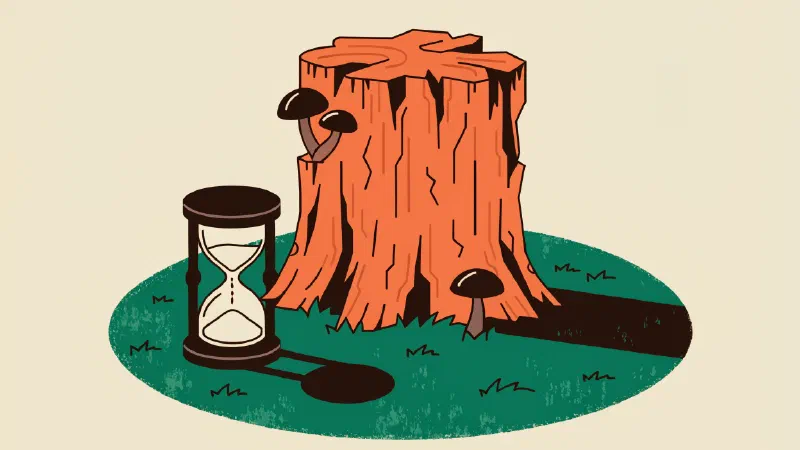
How long a stump takes to rot on its own
Leaving a stump to break down naturally instead of having it ground out is a genuine option, and for some people it’s the preferred one. What’s less well understood is just how long that actually takes, and it’s usually a lot longer than people expect.
A wide range depending on the wood
There’s no single answer, because how long a stump takes to rot depends heavily on what kind of tree it was, its size, and the local conditions. As a rough general range, a stump can take anywhere from three to ten years to break down naturally, but that range stretches much further at either end depending on the species involved.
Softer timbers tend to go faster. Softwoods often break down within five to seven years under decent conditions, though some estimates for species like pine put full decomposition closer to fifteen to twenty years in cooler or drier climates. Hardwoods are the other end of the scale entirely: dense hardwood stumps can persist for forty years or more before they’ve fully returned to soil. Given how many South East Queensland yards have hardwood species like eucalypts, that’s a long time to have a stump sitting in the middle of the lawn.
What actually breaks the wood down
Decomposition isn’t just physical weathering; it’s driven mainly by fungi. Wood-decay fungi work in two main ways: white-rot fungi target lignin, the compound that gives wood its rigidity and structural strength, while brown-rot fungi mainly break down cellulose instead. Lignin in particular is notoriously resistant to breakdown, which is a big part of why hardwood stumps, which tend to be higher in lignin, take so much longer than softer timbers.
Size changes the timeline too
Wood type isn’t the only variable. A larger stump has more mass for fungi and bacteria to work through, and a wider surface area buried below ground that stays damp for longer, so a large hardwood stump from a mature tree will generally sit there considerably longer than a smaller stump of the same species. Root spread matters as well; a stump with roots running wide rather than deep tends to have more surface area exposed to soil moisture, which can work in favour of slightly faster breakdown compared with a similarly sized stump with a single deep taproot.
Why moisture and warmth speed things up
Temperature and moisture play a major role in how quickly any of this happens. Warm, consistently damp conditions favour the fungi and bacteria doing the actual decomposing, so a stump sitting in a shaded, moist part of a South East Queensland yard through the wet season will generally break down faster than one sitting in full sun on well-drained ground. Even so, “faster” in this context still usually means years, not months.
Weighing it up
If you’re not in a hurry and the stump isn’t in the way of anything, letting nature take its course is a legitimate choice, it just needs realistic expectations about the timeline. If you’d rather not have a hardwood stump sitting there for the next few decades, grinding it out below ground level gets the area usable straight away rather than waiting on fungi to do the job.
Once a stump is ground rather than left to rot, the leftover material doesn’t have to go to waste; see what to do with stump grindings for practical ways to use it.
Stump Boss handles stump grinding and lawn aeration from North Brisbane to the Sunshine Coast, big, small and hard to reach. If waiting decades isn’t appealing, send a few photos and get a quote for stump grinding.
Stump Boss does stump grinding and lawn aeration from North Brisbane to the Sunshine Coast.