
Lawn drainage for compacted clay blocks
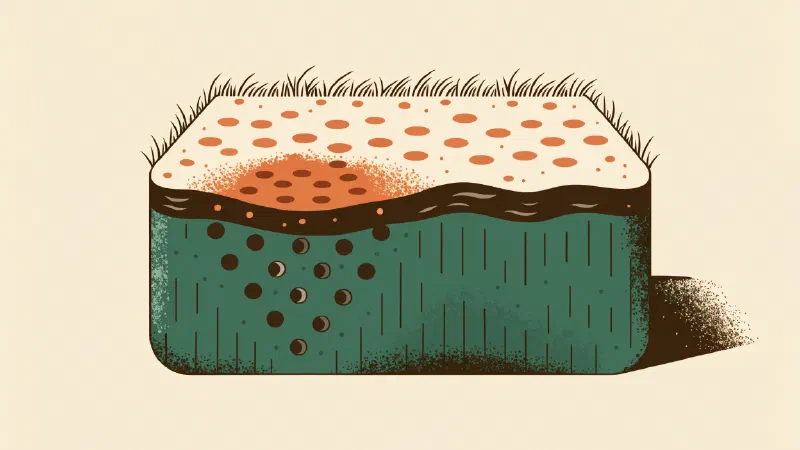
Plenty of South East Queensland blocks sit on heavy clay, and if you’ve noticed your lawn holds water long after the rest of the street has dried out, clay soil underneath is the usual reason. Clay particles pack tightly together, which is good for holding a house slab steady but bad for letting water and air move through to grass roots.
Aeration comes first
The starting point for improving drainage in a clay lawn is aeration, not gypsum or organic matter. Aeration pulls small plugs of soil out of the lawn, creating channels that let water flow through, air circulate and nutrients reach the roots properly, rather than sitting on top of a compacted clay layer. For clay lawns specifically, aerating once or twice a year during the growing season is the general guidance, considerably more often than a sandy soil would need.
Doing this first matters because it opens the ground up before anything else is applied. Mechanical aeration, whether with a garden fork or a proper aerator, helps whatever comes next actually get down into the soil rather than sitting on the surface.
Gypsum: useful, but not universal
Gypsum is the product most associated with clay soil, and for good reason: it interacts with clay particles and helps them clump together into larger aggregates, which creates more space for air and water to move through. But it isn’t a blanket fix for every type of clay. Guidance from DPI NSW specifically advises against using gypsum on non-sodic clays, meaning clay that isn’t high in sodium, since it won’t have the same beneficial effect there. It’s worth getting the soil tested, or at least understanding what type of clay you’re dealing with, before assuming gypsum is the answer.
Organic matter does the long-term work
Alongside or after gypsum, working organic matter into the soil, compost, pine bark, composted leaves, helps rebuild the structure of the soil over time rather than just treating a symptom. As a general guide, a layer worked into the top of the soil helps eliminate drainage and compaction problems that gypsum alone won’t fully solve, particularly where the clay has been compacted by building work or heavy traffic during construction.
Testing before you commit to a product
Since gypsum’s benefit depends so heavily on whether the clay is actually sodic, a simple test strip approach is worth doing before treating the whole lawn. Applying it to one small, contained section first and checking whether the soil structure noticeably improves over the following weeks is a cheap way to confirm it’s the right product before spending on enough gypsum to cover an entire block. If that test section shows no real change, organic matter and ongoing aeration alone are a more reliable long-term investment than repeated gypsum applications.
Putting it in order
The sequence that actually works is aeration first, to physically open the ground up, then gypsum or compost worked in afterwards so it can get down into those newly opened channels rather than sitting on the surface. Doing it in the wrong order, gypsum or compost spread over unaerated, compacted clay, means most of it never makes it past the top few centimetres.
If waterlogging after rain is the main symptom rather than ongoing hard ground, fixing a waterlogged lawn after the wet season covers the other common causes alongside clay.
Stump Boss handles stump grinding and lawn aeration from North Brisbane to the Sunshine Coast, big, small and hard to reach. If your clay block lawn needs proper drainage work, send a few photos and get a quote for lawn aeration.
Stump Boss does stump grinding and lawn aeration from North Brisbane to the Sunshine Coast.