
Palm stumps: why they grind differently
A palm stump looks like it should be a simple job compared to a hardwood tree, and in some ways it is, but the reasons why come down to a completely different root structure underneath.
No taproot, just a mass of fibre
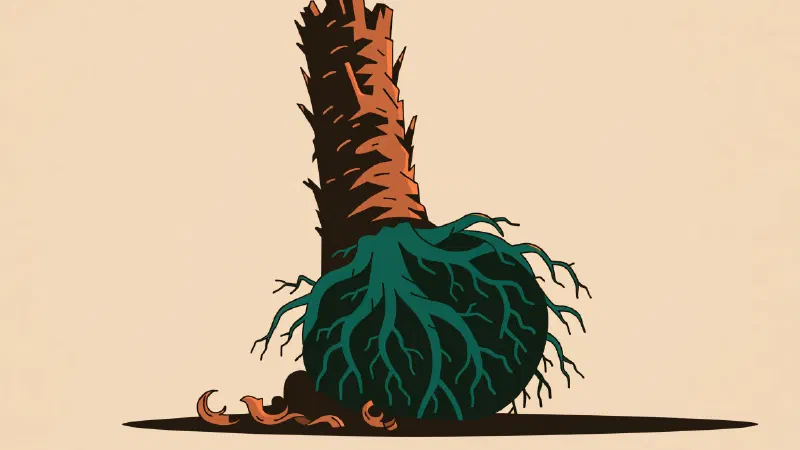
Most trees that end up needing stump grinding, gums, figs, poincianas and the like, have a woody structure with a central root system and lateral roots spreading out from it. Palms don’t work that way. According to Just Stump Grinding, common backyard species like golden cane, queen (cocos), royal and bangalow palms all have long, intertwining fibrous roots that grow in dense clusters rather than a single taproot. There’s no one main root to cut through and no long lateral roots running out under a lawn or path the way there often are with hardwoods.
That fibrous structure is also why digging a palm stump out by hand is harder than it looks. The roots don’t cut cleanly the way woody roots do; a pickaxe or mattock can bounce straight off them if there isn’t enough force behind the swing, since the fibres flex rather than split.
A different grinding approach
The fibrous, moisture-packed structure of a palm stump means it’s ground differently to a hardwood. Fullboar Land Management’s guidance describes starting at the outer edge of the stump and working inward toward the centre, rather than driving straight through the middle the way you might with a solid hardwood trunk. Where the root ball spreads wide near the surface, that outer mass is often grated down separately before working into the core.
Why palm stumps don’t come back
Here’s the practical upside. Unlike hardwoods such as camphor laurel or jacaranda, which can send up new shoots from root fragments left in the ground, a palm only grows from a single growing point at the crown of the plant. Once that growing point is ground out, there’s no other part of the root system capable of producing new growth. A palm stump that’s been properly ground below ground level simply doesn’t resprout, which isn’t something you can say about every species in a South East Queensland yard.
Species matters less than root ball size
Whether it’s a smaller golden cane clump or a tall, single-trunk bangalow or queen palm, the same fibrous root structure applies across common backyard palm varieties. The main variable that changes from one job to the next isn’t the species so much as the size of the root ball itself, since a mature palm that’s been in the ground for decades will have a noticeably wider fibrous mass to grind through than a younger specimen, even though the underlying structure is the same.
What this means for the job
Because the root structure is fibrous rather than woody and doesn’t spread the same way a hardwood’s lateral roots do, a palm stump is often a comparatively quicker grind, provided the machine can get to the full width of the root ball rather than just the visible trunk. The trade off is that the root ball itself can be wider than it looks from the surface, so it’s worth having the full spread checked before assuming it’s a small job.
For a tree that’s the opposite story entirely, one that keeps coming back unless every bit of root is removed, see poinciana and jacaranda stumps: buttress roots and regrowth.
Stump Boss handles stump grinding and lawn aeration from North Brisbane to the Sunshine Coast, big, small and hard to reach. If you’ve got a palm stump to deal with, send a few photos and get a quote for stump grinding.
Stump Boss does stump grinding and lawn aeration from North Brisbane to the Sunshine Coast.