
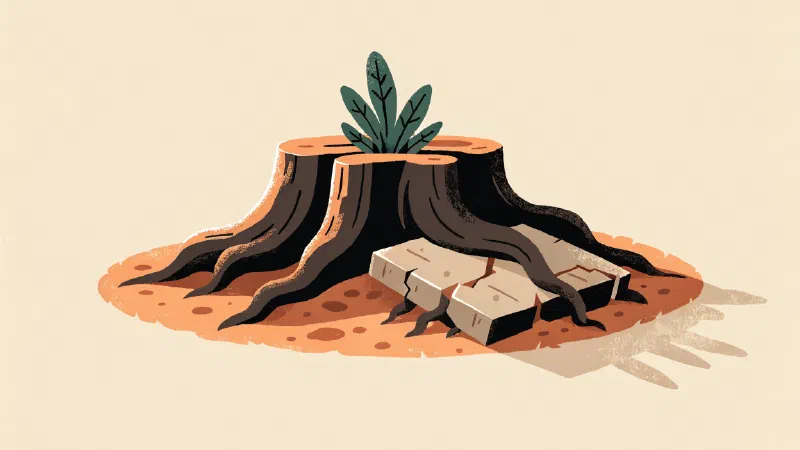
Poinciana and jacaranda stumps: buttress roots and regrowth
Poinciana and jacaranda are two of the more common large trees across South East Queensland yards, and both leave behind a stump that behaves differently to a typical hardwood. If you’ve got one of either sitting in the yard, it’s worth understanding why before deciding what to do about it.
Poinciana: a surface rooting tree
Poinciana trees are surface rooting, meaning much of the root system sits near or at ground level rather than growing deep, in a similar pattern to a fig tree. According to Brisbane Trees, these buttress roots often extend right to the surface and spread well beyond the trunk. That’s a large part of why poinciana roots are such a common cause of lifted and cracked driveways, paths and footpaths: the roots aren’t buried deep enough to avoid whatever concrete happens to be poured above them.
Once a poinciana is removed, the stump left behind reflects that same root structure. Rather than one central taproot, you’re dealing with a wide, flattened base with roots radiating outward near the surface, some of which may already be under a path or driveway edge. A stump like this needs enough grinding depth and outward reach to deal with the roots that are actually causing the damage, not just the visible trunk.
Jacaranda: a stump that fights back
Jacaranda is a different problem entirely. According to Brisbane City Council’s own weed management page, Jacaranda mimosifolia is fast growing and resprouts easily if damaged, and it’s listed as Council Pest Vegetation under the local law because of how readily it spreads. The council’s guidance is specific about what it takes to actually stop it: large jacarandas must be ring-barked or cut down below ground level, with any regrowth then treated, because the species is described as very difficult to control once established.
Jacarandas are also prone to producing suckers, new shoots that come up from the base of the tree or directly from the roots. That means a jacaranda stump that isn’t ground out properly, or where root fragments are left behind, can keep sending up new growth for a long time afterwards, well away from where the original trunk stood.
Both are common enough to plan for
Poinciana and jacaranda are both widely planted ornamental trees across older South East Queensland streets and yards, prized for their flowering display, which is exactly why so many properties end up with one of these two stump types eventually. Knowing which one you’re dealing with before arranging removal is useful, since it changes what actually needs to be checked: how far the buttress roots have spread under nearby concrete for a poinciana, or how much of the root system needs to come out to stop a jacaranda sending up fresh suckers weeks later.
Why this changes what a proper removal looks like
Both species make the case for grinding a stump below ground level and dealing with the surrounding root system, rather than just cutting the trunk back to ground height. For a poinciana, that means following the surface roots out far enough to catch what’s actually cracking the concrete. For a jacaranda, it means grinding deep and wide enough that there’s no live root tissue left to send up suckers weeks or months later.
Camphor laurel is another South East Queensland species with its own regrowth problems for similar reasons; see camphor laurel stumps in South East Queensland for how that one behaves.
Stump Boss handles stump grinding and lawn aeration from North Brisbane to the Sunshine Coast, big, small and hard to reach. If you’ve got a poinciana or jacaranda stump causing grief, send a few photos and get a quote for stump grinding.
Stump Boss does stump grinding and lawn aeration from North Brisbane to the Sunshine Coast.