
Signs your lawn has compacted soil
A lawn that’s struggling doesn’t always have a disease or a pest behind it. Often the problem is simpler and less visible: the soil underneath has become so compacted that water, air and nutrients can’t get down to the roots. It’s a common issue in Australian yards, particularly anywhere with regular foot traffic, kids or pets running the same paths, or a driveway or path that funnels everyone across the same strip of grass.
Water sits instead of soaking in
One of the clearest signs is what happens straight after rain or a good watering. On healthy soil, water soaks in reasonably quickly. On compacted soil, it pools in low spots or runs off the surface altogether, because there isn’t enough space between soil particles for it to move through. If you’re noticing puddles hanging around on the lawn well after everyone else’s yard has drained, compaction is a likely cause.
Grass that thins out and struggles in summer
Different grasses show compaction stress differently. Buffalo lawns tend to show it through reduced tillering (fewer new shoots) and yellow patches, especially under summer heat. Couch lawns often go thin and patchy, with the runners failing to spread properly into the compacted ground. If your lawn looks fine through the cooler months but falls apart every summer in the same spots, it’s worth checking whether those spots are also the ones that get walked on the most.
Weeds that shouldn’t be there
Compacted soil favours certain weeds over grass. Taprooted weeds like dandelion, thistle and similar deep-rooted plants can push through hard ground more easily than shallow grass roots can, so a sudden increase in these types of weeds in one section of lawn is often a compaction signal rather than a weed problem on its own. Bare patches where nothing seems willing to grow, away from any obvious path or shade, point the same way.
It’s often worst near paths and driveways
Compaction rarely spreads evenly across a whole lawn. It tends to concentrate exactly where the traffic is heaviest: a strip beside a driveway where people cut the corner, the path from the back door to the clothesline, or the section of yard a mower always turns on. If the symptoms above are showing up in a specific, repeatable strip rather than scattered randomly, that pattern itself is a useful clue that foot or vehicle traffic, rather than a soil type problem across the whole block, is driving it.
The screwdriver test
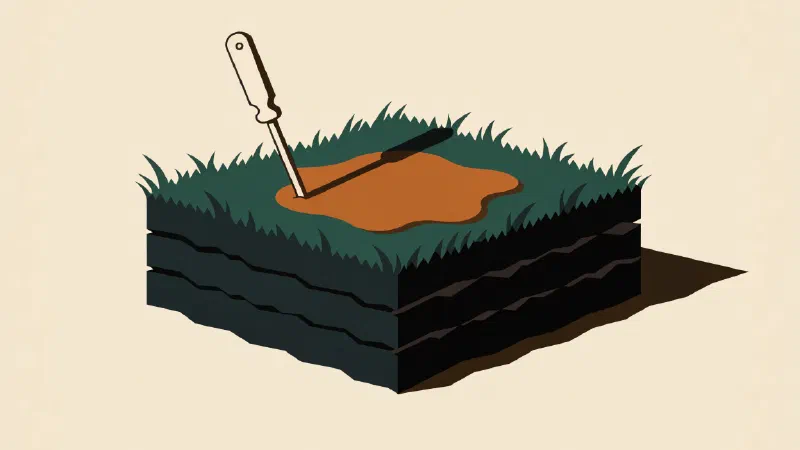
You don’t need equipment to get a rough read on this. Try pushing a garden fork or a long screwdriver into the lawn in a few different spots. If it goes in easily in most of the yard but meets real resistance in a specific area, that area is more compacted than the rest, and that’s usually where the other symptoms above will be showing up too.
What actually fixes it
Aeration is the standard fix: pulling small plugs or slots out of the lawn to open up channels for water, air and nutrients to get through the compacted layer. How often it needs doing depends on the soil. Clay-heavy lawns often need aerating annually, while sandy soils, which don’t compact the same way, can usually go two to three years between treatments. It’s not a once-off job in most Australian conditions; it’s routine maintenance for anywhere with regular traffic or clay-based soil.
If drainage is the bigger issue rather than just compaction, lawn drainage for compacted clay blocks goes into what else helps once aeration alone isn’t enough.
Stump Boss handles stump grinding and lawn aeration from North Brisbane to the Sunshine Coast, big, small and hard to reach. If your lawn needs aerating, send a few photos and get a quote.
Stump Boss does stump grinding and lawn aeration from North Brisbane to the Sunshine Coast.