
Stump Grinding vs Stump Removal: Which One Do You Need
If you’re looking up how to remove a tree stump, or you just want to get rid of stumps taking up space in the yard, you’ve probably seen both terms thrown around: stump grinding and stump removal. They sound similar but they’re two different jobs, and picking the wrong one means paying for work you didn’t need.
What each one actually does
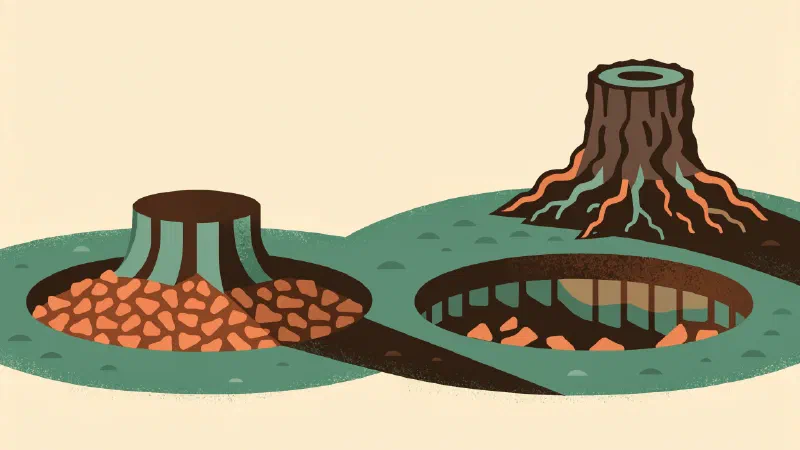
Stump grinding uses a machine with a rotating cutting wheel to chew the stump down to well below ground level. The wood is turned into chips as it goes. The roots are left in the ground to break down naturally over the following years. It’s quicker, less disruptive to the surrounding yard, and leaves you with a pile of wood chips you can use as mulch or have taken away.
Stump removal is a bigger job. It means digging out the whole root system, not just the visible stump, so the machinery and hand tools have to get in under the ground and pull roots out that can spread a metre or more from the trunk, sometimes considerably further on a mature tree. It leaves a much bigger hole that needs backfilling, and it takes longer because of the excavation and cleanup involved.
How long each one actually takes
This is where the two jobs feel most different in practice. A skilled operator can usually grind a typical residential stump in an hour or two, depending on its size and the timber. Full removal is a different scale of job again: once you add the digging, the root cutting, hauling the root ball out and then backfilling the hole properly, it can easily take half a day or longer for a single stump. That time difference is a big part of why removal costs more and why most people who just want a stump gone, rather than a hole gone, choose grinding instead.
How to remove a tree stump: when grinding is the right call
Most residential jobs are grinding jobs. If you want the stump gone so you can mow over it, lay turf, or put in a garden bed, grinding gets you there without digging up half the yard. It’s the faster, less invasive option, and it’s what most homeowners actually need when the goal is just “get rid of the stump.”
When you need full removal instead
Full removal earns its extra cost and disruption when you need the ground completely clear of roots, not just the stump. That matters if you’re:
- Building something on that exact spot, like a shed slab, a retaining wall, or a driveway extension
- Planting a new tree in the same hole and want the old root system out of the way first
- Dealing with a species known for aggressive root suckering, where grinding alone can leave the roots able to throw up new shoots
The trade off in plain terms
Grinding is faster and less disruptive, but it leaves the root system in the ground to decay over time. Removal clears the roots properly, but it’s a bigger, messier job that takes longer and costs more because of the excavation and backfill work involved. For most yards, grinding solves the actual problem: a stump you can’t mow around, that’s in the way of new turf or garden beds, or that’s simply an eyesore.
If you’ve got several stumps on the same block, or one particular stump you’re not sure about, sending photos gets a more useful answer than guessing off a general rule.
A quick way to decide
Ask yourself what’s actually happening to that patch of ground next. If the answer is turf, a garden bed, or just “I want to mow over it,” grinding is almost always the right call, and it’s the option that gets the yard usable again the fastest. If the answer involves a slab, a footing, a retaining wall, or planting a new tree in exactly that spot, removal is worth the extra time and cost, because grinding alone won’t clear the roots that a build or a new planting actually needs out of the way.
Stump Boss grinds stumps big, small and hard to reach, from North Brisbane to the Sunshine Coast. Send a few photos for a quote and find out which job you actually need.
Related reading: will a stump grow back after grinding? Service page: stump grinding
Stump Boss does stump grinding and lawn aeration from North Brisbane to the Sunshine Coast.