
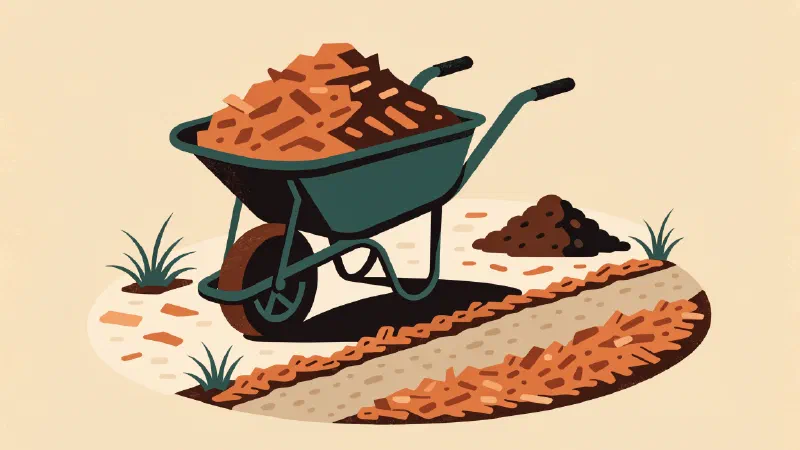
What to do with stump grindings
Once a stump has been ground out, you’re usually left with a decent pile of woody material sitting on the lawn. It’s tempting to just have it carted off, but there are a few genuinely useful things you can do with it first.
Mulch is the obvious one
Stump grindings make solid mulch. Spread as a layer roughly eight to fifteen centimetres deep around garden beds, they help insulate the soil, hold moisture in over hot South East Queensland summers, and make weeding noticeably easier, since a decent mulch layer blocks the sunlight weed seedlings need to get going. Trees generally want a deeper layer than smaller plants; go heavier around an established tree or shrub and lighter around perennials and garden edges.
Filling the hole
One of the simplest uses is right where the stump used to be. Grindings can fill most of the depression a stump grinder leaves behind, topped off with a layer of quality topsoil once the grindings have settled. It’s a practical way to deal with material that’s already on site rather than having it removed and then buying fill separately.
Composting, if you’ve got the patience
If mulch isn’t what the yard needs, grindings can go into a compost pile instead. Mixed in with other organic waste, they’ll generally break down within a few months. There’s one thing worth knowing before you do this, though: fresh grindings are high in carbon and low in nitrogen, so on their own they can actually rob nitrogen from whatever they’re mixed with rather than adding to it. Mixing them with nitrogen-rich material, manure, food scraps, or a fertiliser, balances that out and speeds the process along rather than stalling it.
Sharing or getting rid of the surplus
If there’s more material than the yard can realistically use, offering the surplus to a neighbour or a local gardening group is usually easier than paying to have it carted away separately. Wood chips are generally welcomed by anyone with garden beds of their own, and it saves the extra cost and hassle of arranging separate removal for material that still has a genuine use, just not necessarily on your own block.
Paths, play areas and ground cover
Wood chips from grinding also work well as a natural surface for garden paths, under a swing set or trampoline, or anywhere in the yard where grass struggles to establish anyway. They’re not a permanent surface, they’ll break down and need topping up over time, but they’re a low cost way to cover an area that would otherwise just be bare dirt or mud after rain.
How much you’ll actually have
The volume of grindings left behind scales with the size of the stump itself, so a small ornamental tree might leave a modest pile that’s easily worked into one or two garden beds, while a large established hardwood can leave considerably more than most yards can use as mulch alone. It’s worth deciding what you’re doing with the material before the job happens, mulch, hole filling, compost, or a combination, rather than ending up with a large pile and no plan for it afterwards.
The one thing to watch
The same carbon to nitrogen imbalance that matters for composting matters even more if you’re spreading fresh grindings directly around living plants or trying to establish new grass nearby. Piled straight onto soil where something is meant to be actively growing, they can pull nitrogen away from the plant roots as they decompose. If that’s the situation you’re in, grass dying where the stump was: why it needs more than water covers exactly why that happens and how to get around it.
Stump Boss handles stump grinding and lawn aeration from North Brisbane to the Sunshine Coast, big, small and hard to reach. Send a few photos and get a quote for stump grinding.
Stump Boss does stump grinding and lawn aeration from North Brisbane to the Sunshine Coast.