
Top dressing: sand or soil mix for South East Queensland lawns
Top dressing is one of those lawn jobs that gets recommended constantly, but the choice between sand and a soil mix depends entirely on what problem you’re actually trying to solve.
Soil mix: for feeding and thickening
A soil-based top dressing blend, generally a mix of screened loam or topsoil, compost such as cow manure, and coarse sand, is the better pick if the lawn needs a nutrient boost. According to Lawn Solutions Australia, a soil mix thickens turf, encourages new growth, and supports better pest and weed resistance overall. This is the option for a lawn that’s thin, patchy from wear, or just generally lacking vigour rather than one with a specific surface levelling problem.
Washed sand: for levelling and drainage
Washed pit sand is the better choice when the actual issue is uneven ground, low spots that collect water, or general levelling, according to Centenary Landscaping’s comparison of the two options. Sand doesn’t add much in the way of nutrients, but it’s a straightforward and budget friendly way to fix surface irregularities without changing the soil’s fertility.
A common blend for most home lawns
For most home lawns that don’t have a specific levelling problem to solve, a blended approach is often recommended: roughly 80 percent washed sand combined with 20 percent black soil or organic material. That ratio gives some of sand’s drainage benefit alongside enough organic content to actually feed the lawn, rather than choosing one extreme or the other.
Spreading it evenly
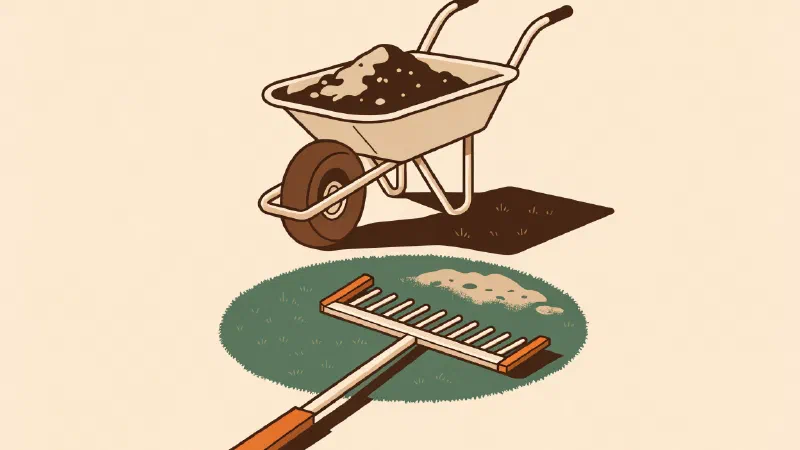
However it’s applied, the goal is an even layer rather than uneven mounds that smother some sections while leaving others untouched. A wheelbarrow and a flat-backed rake or a stiff broom worked across the lawn in a couple of directions gets the material down into the base of the grass rather than just piled on top, which matters more for how well it settles than which exact product you’ve chosen to use.
How much and how often
Whichever mix you’re using, the same rule applies: never apply more than about a centimetre in a single pass, and make sure the grass tips are still visible above the layer once it’s down. Burying the lawn under a thick layer of top dressing in one go can smother the grass rather than help it, so it’s better to apply a thin layer and repeat later if more is needed than to overdo it once.
Watering in afterward
Once a top dressing layer is down, a light watering helps settle it in around the existing grass blades rather than leaving it sitting loosely on the surface where it can wash away in the next decent rain. This matters more with a sandier mix, which settles less naturally than a soil blend with more organic material holding it together, so a sandier top dressing benefits from that extra step more than a soil-heavy one does.
Timing for warm season grasses
Top dressing should only be done during the active growing season, and earlier in that season is better than later. For South East Queensland’s warm season grasses, buffalo, couch and kikuyu, that means spring through early summer, when the lawn has the most active growth ahead of it to work the new material in and recover from any disturbance. Top dressing a warm season lawn heading into autumn or winter, when growth slows right down, gives the grass far less time to respond before cooler weather sets in.
If kikuyu has spread through a buffalo lawn and left patches that need repair alongside top dressing, see kikuyu creeping into buffalo: control options for dealing with that specific problem first.
Stump Boss handles stump grinding and lawn aeration from North Brisbane to the Sunshine Coast, big, small and hard to reach. Send a few photos and get a quote for lawn aeration if top dressing is part of a bigger job.
Stump Boss does stump grinding and lawn aeration from North Brisbane to the Sunshine Coast.