
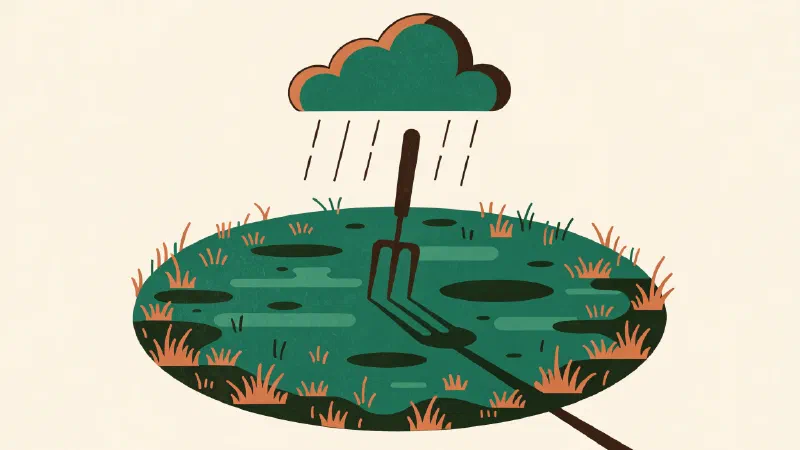
Fixing a waterlogged lawn after the wet season
Once the wet season eases off, a lot of South East Queensland lawns are left sitting under water in the same low spots, week after week, even once the rain itself has stopped. According to Lawn Solutions Australia, a waterlogged lawn is rarely just “too much rain”; it’s usually one of a handful of specific causes, and each one needs a different fix.
Step one: stay off it
Before anything else, keep foot traffic to a minimum until the area actually has a chance to dry out. Walking on waterlogged ground compacts it further and can leave lasting divots in what’s already a soft, saturated lawn. It’s tempting to get straight into fixing it, but a day or two of staying off the affected area first makes every following step easier.
Working out which cause you’ve got
Lawn Solutions Australia sets out four common causes, each with its own signs and fix:
- Compacted soil. If water sits and doesn’t move even after the ground has had a chance to dry, compaction is a likely cause. Aerating with a garden fork, pushing it into the ground and wiggling it to open up the soil, is the standard fix.
- High clay content. Clay-heavy soil holds water because the particles are packed tightly together. Gypsum is the typical treatment, working to break the clay into a more crumbly texture that lets water move through rather than sit on top.
- Excess thatch. A thick thatch layer between the soil and the grass can act like a sponge, holding water at the surface. Dethatching, whether by mowing pattern, a dethatching rake, or a machine, clears that layer out, and is best done once conditions warm up in spring or summer.
- Hydrophobic soil. Some soils develop a waxy coating that actually repels water rather than absorbing it, which sounds counterintuitive on a lawn that’s supposedly too wet, but it’s a real cause of water pooling on the surface instead of soaking in. A wetting agent helps break down that coating so water can actually penetrate.
If none of these seem to fit, poor grading, meaning the ground doesn’t slope away from the problem area, may be the actual cause, and that’s a job for a landscaper or drainage specialist rather than a lawn treatment.
More than one cause can be in play at once
It’s worth keeping in mind that these four causes aren’t mutually exclusive. A lawn on compacted clay soil, for instance, can also have developed a hydrophobic surface after a long dry spell before the rain arrived, meaning both the compaction and the water repellent layer need addressing rather than just one or the other. Working through the checks in order, starting with the simplest to rule out, compaction and thatch are both easy to check by hand, helps avoid treating for the wrong cause and missing a second one sitting underneath it.
After the water’s gone
Waterlogging leaches nutrients out of the soil, so once the lawn has dried out and the underlying cause is addressed, it’s worth feeding it to replace what’s been lost. Watch for fungal disease too; waterlogged lawns are more prone to it, so any brown, slimy or matted patches are worth acting on quickly rather than waiting to see if they clear up on their own.
If clay soil turns out to be the main culprit, lawn drainage for compacted clay blocks goes into more detail on fixing that specific cause properly.
Stump Boss handles stump grinding and lawn aeration from North Brisbane to the Sunshine Coast, big, small and hard to reach. If your lawn needs aerating after a wet season, send a few photos and get a quote for lawn aeration.
Stump Boss does stump grinding and lawn aeration from North Brisbane to the Sunshine Coast.